PreK to Grade 12
The Quran and the transcript, held to the same standard.
Two periods of Arabic and Quran every day, fourteen AP courses, and one set of expectations across both. Here is what a year actually looks like in each band.
PreK and Kindergarten, ages 3 to 6
Early Years
The room is capped at fourteen children with two adults in it. Mornings are phonics, number sense and a lot of talking out loud. Afternoons are centers, outdoor time and Arabic by ear. Full day PreK adds a rest period after lunch. Your child will come home able to tell you what they did, which is the actual test of whether a PreK room is working.
Core academics
- Phonics through a structured, sequential program rather than guessed sight words
- Number sense to 20 in PreK, to 100 in Kindergarten, with manipulatives before worksheets
- Fine motor, scissors and pencil grip taught deliberately, not left to chance
- Outdoor time twice daily, weather allowing
Islamic studies and Arabic
- Short surahs learned by ear before any writing begins, usually Al-Fatihah through An-Nas by the end of Kindergarten
- Arabic letters by sound and shape, with the alphabet secure before Grade 1
- Wudu and the physical form of salah taught practically, in the room, with time to get it wrong
How it is assessed
No grades and no report card averages. Two individual reading and number assessments a year, in October and January, and a twenty minute conference with you after each.
By the end of Kindergarten a child on the standard track reads decodable text independently and has Juz' Amma's short surahs by heart. If your child is not there in January, you will hear it from us in January.
Grades 1 to 8
Lower and Middle School
Two academic blocks bracket Dhuhr and lunch. Quran memorization starts in Grade 2 at thirty minutes every morning. From Grade 6 the day shifts to subject teachers and lockers, math streams into two tracks, and students start managing their own deadlines with a lot of scaffolding in Grade 6 and much less by Grade 8.
Core academics
- Math streamed from Grade 6, so students on the accelerated track finish Algebra I in Grade 8 and enter high school a year ahead
- Writing across the curriculum, with a graded research paper every year from Grade 4
- Science in a dedicated lab from Grade 5, with hands on labs rather than demonstrations
- Texas history, US history and world geography, taught to the state scope so a transfer out is never a setback
Islamic studies and Arabic
- Quran memorization from Grade 2, thirty minutes daily, streamed by level rather than by grade
- Tajweed taught formally from Grade 3, with the rules named and applied rather than imitated
- Arabic as a living language: conversation and composition alongside Quranic vocabulary
- Seerah in Grades 4 and 7, fiqh of worship in Grades 5 and 8
How it is assessed
Standards-based report cards four times a year, plus MAP Growth testing in fall and spring so you can see progress against a national sample rather than only against this classroom.
Grade 5 leaves with three juz' memorized on the standard track and Juz' 30 secure enough to lead taraweeh in Ramadan. Grade 8 leaves with six juz' on the standard track and the full Quran on the hifz track.
Grades 9 to 12
Upper School
A college-preparatory transcript with Arabic and Quran still in the schedule every day. Students take fourteen AP courses and dual credit through Collin College inside the school day rather than in the evening. College counseling starts in Grade 10, with one counselor for every 32 seniors.

Core academics
- Fourteen AP courses: Calculus AB and BC, Biology, Chemistry, Physics 1, Statistics, English Language and Literature, US and World History, Psychology, Computer Science A, Human Geography and Art History
- Dual credit through Collin College in English, government and speech, taken on our campus
- Four years of math and science required, not three, which is above the Texas minimum
- Senior capstone: a researched, defended project in a subject the student chooses in Grade 11
Islamic studies and Arabic
- The hifz track runs alongside the full college-prep load, not instead of it. Students on it graduate with the same transcript as everyone else
- Advanced Arabic to the point of reading unvowelled classical text
- Islamic ethics and contemporary fiqh in Grades 11 and 12, taught as argument rather than as a list of rulings
How it is assessed
Standard GPA and transcript, AP exams in May, PSAT in Grade 10 and 11 and school-day SAT in Grade 11. Nothing here is non-standard, so a transfer to any US high school or university reads it without a translation.
All 41 graduates in the Class of 2026 were admitted to four-year programs, average SAT 1,240, school-reported. Eleven of them completed hifz while they did it.
Two periods, every day
The Quran and Arabic track
This is the reason a family chooses an Islamic school over a good public school, so it gets more than a bullet point.
Streamed by level, not by grade
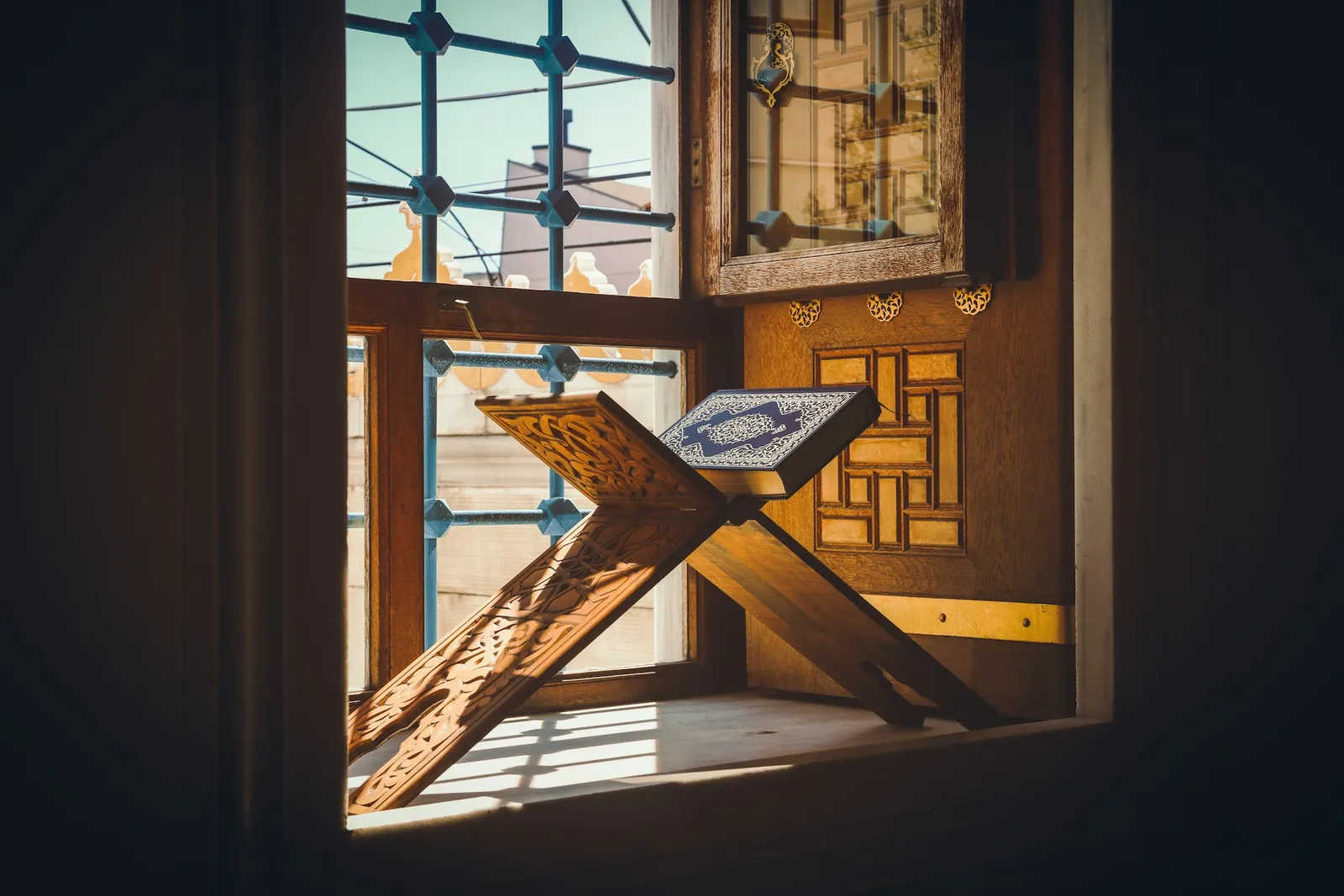
A Grade 4 student who has three juz' does not sit through the same halaqah as a Grade 4 student who arrived in September. Quran and Arabic are the two periods of the day where students move to the group that matches where they are. Nobody is held back for the room and nobody is dragged along behind it.
The hifz pathway
Students may enter the full hifz track from Grade 5. It adds a second daily session and continues through Grade 12 alongside the regular academic load. Thirty-eight students have completed the Quran at Cedarbrook since the program opened in 2011, and eleven of them were in the Class of 2026. There is no separate, lighter transcript for hifz students.
Tajweed taught as rules
From Grade 3 the rules are named, written down and applied, rather than picked up by imitation. A student should be able to tell you why a madd is six counts here and two counts there. Two of our Quran faculty hold ijazah, and recitation is assessed one to one every term.
Arabic as a living language
Quranic vocabulary is the floor, not the ceiling. Students conduct conversation, write composition and read modern standard Arabic. By Grade 11 the advanced group reads unvowelled classical text. A student who has been here since Grade 1 leaves able to speak with an Arab relative, not only to decode a page.
When would my child finish?
Every school will tell you its Quran program is strong. This tells you the year. Set your child's grade and what they already have, and the table runs to Grade 12.
Your child is in Grade 4 next year. The full hifz track begins in Grade 5, and at five juz’ a year that is 30 juz’ complete in Grade 10, with two years left for AP exams.
| Grade | Year | Juz’ by June |
|---|---|---|
| Grade 4 | 2027-28 | 0track starts Grade 5 |
| Grade 5 | 2028-29 | 5 |
| Grade 6 | 2029-30 | 10 |
| Grade 7 | 2030-31 | 15 |
| Grade 8 | 2031-32 | 20 |
| Grade 9 | 2032-33 | 25 |
| Grade 10 | 2033-34 | 30Complete |
| Grade 11 | 2034-35 | 30 |
| Grade 12 | 2035-36 | 30 |
The rates this uses
- Standard. Thirty minutes daily, begins Grade 2. Two juz’ every three years.
- Accelerated. One extra period, begins Grade 3. Two juz’ a year.
- Full hifz. Two periods daily plus about forty-five minutes at home, begins Grade 5. Five juz’ a year.
Rates are what we actually observe, not a promise. Children move between tracks and we re-place at the start of each year.
Two weeks a year, planned around
Ramadan and Eid
The part of the calendar parents ask about first and almost no school website answers. Here is the schedule, including the piece of it we have not settled.
The Ramadan day
School runs 8:00 to 1:45 for the whole month. Both academic blocks stay, the lunch period comes out, and Dhuhr moves to 1:30 so families can leave straight after it. Aftercare does not run in Ramadan.
Fasting is not supervised
Students in Grade 4 and above who are fasting stay in their rooms through what would have been lunch. Students who are not fasting eat in Room 118. Nobody keeps a register of who is doing which, and no teacher will ask your child why.
Taraweeh and the last ten nights
The school does not run taraweeh. The masjid across Legacy Trail does, and upper school students on the hifz track lead two rak'ahs there on Fridays. School closes for the last three weekdays before Eid al-Fitr.
Eid closures
Closed two weekdays for Eid al-Fitr and two for Eid al-Adha, confirmed once the moon is sighted rather than fixed in the printed calendar. If Eid falls on a Saturday, the Friday is the closure.
The 1448 calendar is not finalized
We have not set the Ramadan 1448 dates yet, because the board wants them agreed with the masjid first. They go up on this page in January and go out to enrolled families by email the same week. If you are choosing between schools now and need them sooner, call the office and ask for Sr. Hana.
Class of 2026
Where the Class of 2026 went
Forty-one graduates. Every one admitted to a four-year program.
1,240
Average SAT
Class of 2026, school-reported
14
AP courses offered
2026-27 course catalog
68%
Sat at least one AP exam
Class of 2026
$1.9M
Merit aid offered to the cohort
Class of 2026, as reported by families
Where they went, in their own words on their own forms
- UT Austin
- Texas A&M
- UT Dallas
- University of Houston
- Baylor
- SMU
- Purdue
- Georgia Tech
- University of Michigan
- Rice
- TCU
- UT Arlington
3:15 to 5:00
Outside the timetable
Clubs and athletics run from 3:15 to 5:00, and most students do at least one.
Robotics
Two FIRST Tech Challenge teams, Grades 7 to 12. The senior team reached the North Texas regional in 2026.
Student leadership
An elected student council in the upper school runs the Friday khutbah rota, the food drive and the Grade 9 orientation.
Debate
TAPPS competitive debate and Model UN, Grades 9 to 12. Nine students qualified for the state meet in 2026.
Athletics
TAPPS basketball, volleyball, soccer and cross country. Separate boys and girls programs with separate practice times.
Service hours
Forty hours required to graduate, tracked from Grade 9. Most students clear it through the masjid food pantry and the tutoring program.
Quran competition
An annual in-house competition every November, hifz and tajweed divisions, Grades 3 to 12. Visiting families are welcome.
Reading about it only gets you so far.
Come and watch a Grade 4 halaqah, then walk into the AP Chemistry lab twenty minutes later. Tuesdays and Thursdays at 9:00am.